Portable Sawmilling & Tree Surgery
combined
It is a shame that so much great timber is lost
during tree surgery. Usually the cut wood is seen as only waste that
must be cleared as quickly as possible. Usually great timber is cut
up into rings to be split up into firewood, or worse goes to land fill
or fly-tipped by the unscrupulous.
Whenever suitable, possible & with negotiation
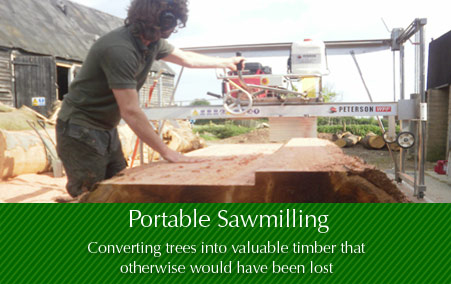
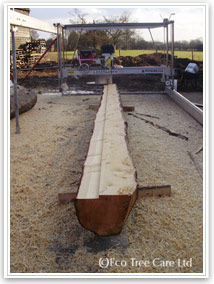
with tree owner we will bring in a portable sawmill to plank up what
we can of the trees that have to be felled. Often what could be valuable
wood is lost to be burnt as firewood. Instead it is possible to convert
this wood into usable and beautiful timber, thus furthering our intention
to make tree surgery a more sustainable and environmentally friendly
industry. And of course it just simply makes sense.
(See also "Portable
Sawmilling - The End Results")
|

|
Hunsdonbury
Copper Beech
North Mymms Oaks (Below) |

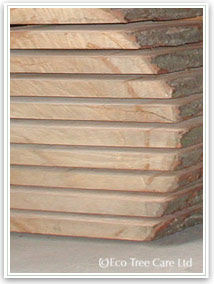
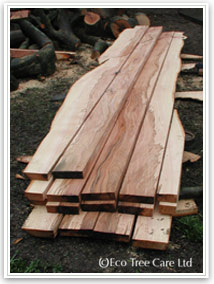
Some of the photos show how we managed
to save some lovely beech timber that otherwise would now be firewood.
The tree was a beautiful copper beech and some 200 year old growing
in a garden in Hunsdonbury, nr Ware, Herts. Unfortunately this
tree was in the final stages of a root decay, caused by a severe
root rot fungus — Meripilus giganteus.
|
|
|
|
|

|
|
Meripilus
giganteus, also known
as the Giant polypore is a common cause of the death and /or windblow
of mature beech trees. It is considered very serious and dangerous
when in an urban environement. When the fruiting body appears
in late summer or autumn it is a sign that the fungus is very
well established and the tree could start to become unstable if
it is not so already. The more numerous the clumps of fruiting
bodies generally the greater the risk. Often
the beech tree will look in good health right until the end, however
if the crown is also thin and dying back, the risk is immediate.
The reason for this is that the fungus destroys the deeper-going
roots, leaving the shallower roots healthy and intact until the
very last.*
However it should be said that this diagnosis
is not clear cut and each tree must be considered on its own individual
merits. There are certain techniques that can be employed to accurately
ascertain the extent of the fungal decay and the likely chance
of failure. This is at the cutting edge of professional arboriculture
and recent articles in arb magazines suggest that too many beech
trees with Meripilus are condemned unnecessarily becasue of fear
of litigation or owners not wishing to pay for procedures which
may save the tree.
|
|
|
|
|
The
tree was considered to be extremely hazardous and its proximity
to nearby houses resulted in the inevitable but painful decision
that it must be carefully dismantled and felled.
After negotiation with the owner we agreed that we would salvage
as much useful timber as we possibly could, using a portable sawmill.
The remainder would be logged for firewood. |
| |
|
|
|
| Dismantling
the tree |
|
|
|
The
tree was carefully dismantled over two wet winter days by
our team of expert tree surgeons. Large branches were lowered
gently to the ground and cleared by the ground team.
|
|
|
|
|
|
|
|
|
|
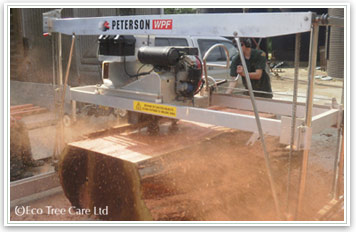
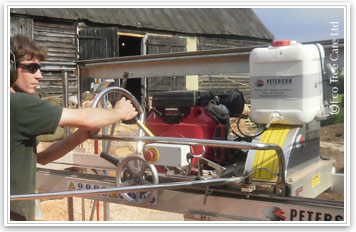
Bringing in the Portable Sawmill
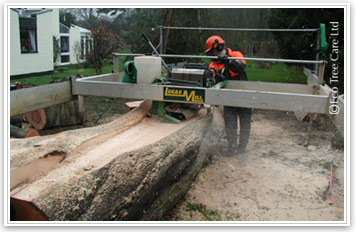
Becasue of its situation in a rear garden with a narrow
access we brought in a portable sawmill which could be disassembled
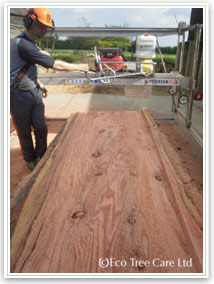
and reassemabled around the felled trunk. After a day of
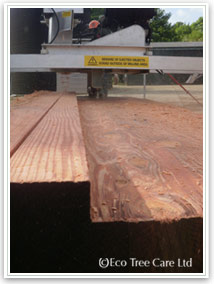
milling we were able to recover much good timber which because
of the fungus had some interesting colouration and markings.
After seasoning this will be made into furniture to live
on its beauty in peoples lives and homes.
|
 |
|
|
|
|
|
|
|
|
 |
 |
At North Mymms Church, near Hatfield,
Herts. Two oaks had grown side by side for about 170 years.
They stood in what is now a car park and quite unexpectedly,
one sunny day, one of the oaks fell over destroying two
parked cars (expensive ones, apparently). Fortunately no
one was injured or worse, but it did mean that there was
a huge oak tree to be cleared up, and the safety of its
sister tree also called into question.
|
 |
|
On inspection the fallen tree had done so because most of
the roots had decayed away under the influence of a fungus
called Ganoderma adspersum. Its sister tree was also unsurprisingly
severely effected and its lean towards the neighbouring house
gave cause for alarm. It was quickly made safe by being dismantled
and felled. |
 |
|
Ganoderma adspersum
is a root and butt rot fungus which eats away at the
lignin component of wood. The result is that the inside
of the roots and, progresively, the trunk turns into
a soft white pith. This pith is the remaining cellulose
component of the wood. Eventually the weakened base
may no longer hold the weight of the tree causing
it, in this case, to fail. |
|
|
|
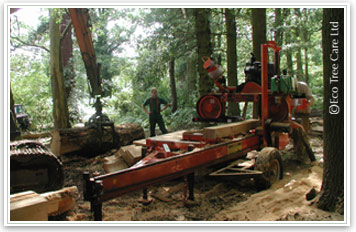
This was a perfect opportunity to
bring in a portable sawmill, lovely straight trunks of oak,
in a car park! Meaning excellent access and space to work.
On this occasion a Woodmizer sawmill was brought in, this
meant it could be driven right up along side the trunks.
|
|
|
|
|
|
|
|
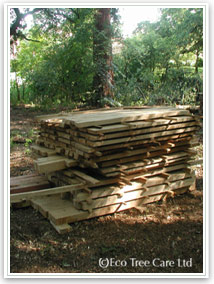
It is always a shame when a large
mature tree has to be removed, but its loss can be mitigated by converting
it into useful wood products. The quality of the resulting timber on
this occasion is self-evident from the photos, demonstrating how with
a bit of thought and consideration tree surgery and woodland management
can be made to be much more sustainable and environmentally friendly
industry. |