

Our Services
Information
Archive & Portfolio
Archive page
This website began in the summer of 2003 and so has seen much content over time. We have made a decision that, for now, rather than delete pages that are no longer being updated, or are for services that we no longer offer, we would instead place them in this archive section to serve as a portfolio, library & as a history
Jobs in Tree Surgery
Routes into Tree Surgery - Arb Jobs - Tree Surgeon Career
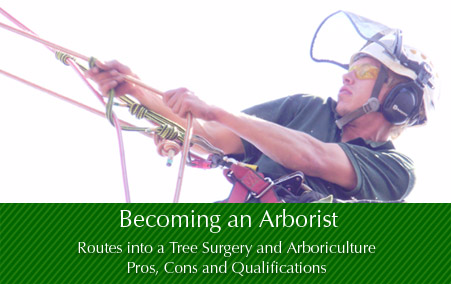
A career in Tree Surgery / Arb / Arboriculture
We receive many enquiries from individuals all over the UK who ask for advice on how to become an arborist / tree surgeon, and what is involved. It may also be interesting for our customers too to read a little about what a career in arb or tree surgery involves.
What follows is a some information on this matter which should help you understand the various routes into the tree surgery industry and what a job in arb involves.
Some important points to consider first
 Tree surgery is a very physically
demanding job
Tree surgery is a very physically
demanding job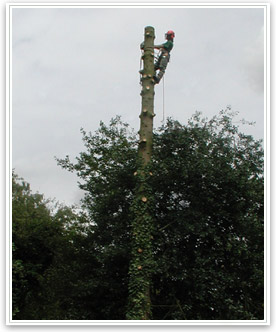
Tree surgery can be dangerous and challanging
Tree surgery involves being outdoors in all
weathers
Tree surgery is highly skilled work
It is noisy, dusty, wet, hot, uncomfortable hard work
Tree surgery will make your muscles ache
However...
Tree surgery can be very satisfying
Tree surgery can be good fun
Tree surgery involves being part of a close-knit team
Trees are amazing, you will never stop learning
The views are great
Routes into Tree Surgery / Arboriculture
Essentially there are two routes to becoming an arborist - there are no short-cuts really, it does require training (See our recommended book lists for useful arb training & tree surgery books).
On the Job
On the job - Employment with training
One route in is by finding a job with a local tree surgery business, and starting
as a trainee tree surgeon/arborist. Generally you will start as a groundsman,
a highly skilled job in itself and also physically demanding. It may take
months even years as a groundsman before starting to climb. You will first
need to be become proficient in the use of chainsaws on the ground and be
put through the necessary NPTC chainsaw certificates.
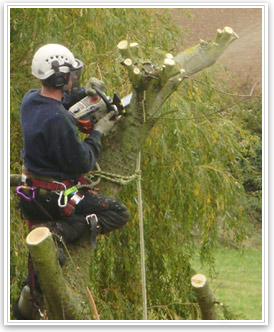
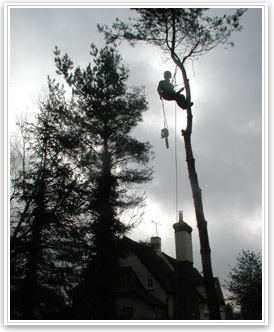
Pros
You will get a chance to experience first hand whether tree surgery is the
job for you and whether you can handle the hard work and conditions
You will gain valuable commercial experience and can build on the theory and
qualifications as you progress as a tree surgeon
Cons
Wages will be initially low, rising with experience and skill level (starting
on perhaps £50-60 a day)
It can be difficult to find a job with a good tree surgery company
You may learn tree surgery techniques and skills that are out of date when
compared to current knowledge and practice. You may pick up bad habits and
then find it harder to change your skills to update yourself
You may only learn how to climb trees and cut bits off with a chainsaw as
opposed to learning to become a skilled arborist. There is a very big difference
On
the job - Volunteering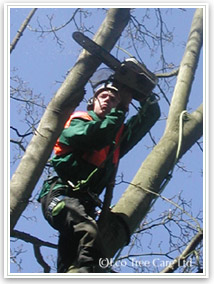
It could be that your personal circumstances or
current employment give you the flexibility to offer
your services as a volunteer. You may be able to
get valuable experience with a tree surgery company
for a day or two a week or more.
This will certainly appeal to many tree surgery businesses who would see this as an opportunity to increase their numbers on certain jobs at little expense.
However for the prospective tree surgeon this is an excellent opportunity to get involved in the industry and get some real 'on the job' experience.
It may also lead to a job if you prove that you are a 'grafter', or at least give you some contacts in the industry.
A word of caution - Do some research into who you are offering your services to. Just because someone is in the Yellow Pages or has a website does not mean that they are a bona fida tree surgery company. Satisfy yourself that they operate a sound and safe business.
If you do volunteer for a company and you find yourself in a clearly unsafe 'cowboy' operation, don't be afraid to walk away. You can also put this down to experience! Don't get killed.
Going to college
The other route to becoming an arborist is to go to a specialist arb college where you can learn the necessary tree surgery skills and gain the qualifications required to be a tree surgeon. See our list at bottom of page.
Pros
You will be taught a broad range of tree surgery skills and theory to give
you a good grounding in arboriculture. You will be starting with a view to
becoming an arborist, not just a tree surgeon.
You will be trained to pass the certificates that qualify you to become a
professional arborist
It will probably be easier to find a job and wages are likely to be higher
intially, or at least rising quicker if you prove yourself to be good. (An
experienced confident climber may be able to earn £120+ a day after
several years)
Your learning will be up to date and you will enter the mind-set of the modern
arb industry. A lot has changed in even the last 5 years. If you go back 20
years it is almost un-recognisable.
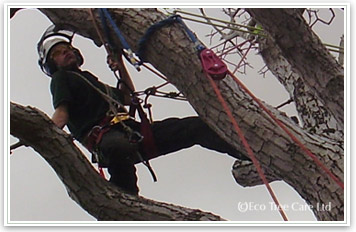
Cons
Having qualifications does not necessarily mean you are a good tree surgeon,
it will still take many years of 'on the job' work to learn how to be a good
arborist in a commercial environment.
What you learn at college doesn't necessarily equip you to deal with the physical
demands and ability to work on all trees. This takes time and experience.
You may hate it as a actual job or find it too physically demanding and will
have wasted time and money
Tree Surgery - A physical & demanding job
It is generally said to take at least two years of climbing in a commercial environment to become strong and fit enough to be a good tree surgeon. It also takes this time to slowly build up confidence to take on larger and larger trees. It can take many more years to excel
Climbing day in and day out for many hours a day, with a chainsaw hanging from your harness, in all conditions & weather is demanding and requires great stamina, both physically and mentally
There will be times, often daily to begin with, when you will need to push yourself and overcome fear and tiredness.
On the whole Tree Surgery is a young persons 'game'. By the age of, say 35, you are old in tree surgery terms, or at least to start. That is not to say that people don't start successful careers in tree surgery at this age or after, only be under no illusion that perhaps when you are 45 you may not want to be climbing trees anymore. There are many excellent tree surgeons that are 'older', sometimes the best. But it is likely that they started young and have learnt early. Bear this in mind if you are thinking of coming into tree surgery and you are 30 or over.
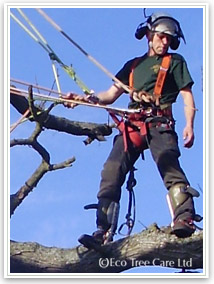
Tree Surgery can be dangerous
It goes without saying that climbing trees with a chainsaw can be a dangerous occupation. Safety precautions, risk assessments, protective clothing, comprehensive training e.t.c. is essential to minimise risk, but accidents do and can happen. There are safer and easier ways to earn money!
Read this from the Health & Safety Executive - Tree Work Accidents
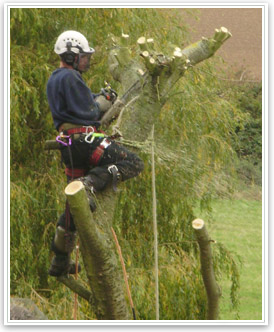
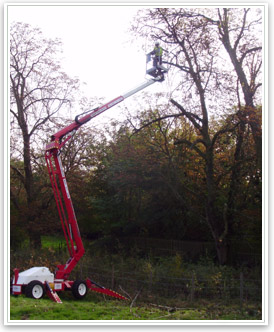
Required qualifications for Tree Surgery Operations
The NPTC chainsaw qualifications below are recognised in the HSE guidance as being the appropriate qualification route for professional chainsaw users.
To equip you for using a chainsaw on the ground
CS30.1 Maintain and operate the chainsaw- maintenance of the chainsaw
CS30.2 Maintain and operate the chainsaw- on site preparation and basic crosscutting
Then
CS31 Fell and process small trees 200mm-380mm
Then to progress off ground you will need
CS38 Climb trees and perfom aerial rescue
Only with these 4 will you be eligable to take the next qualification to take a chainsaw into a tree...
CS39 Operate the chainsaw from a rope and harness
As a rough cost guide for each of the above NPTC tree
surgery courses is in the region of £350 - £550, depending on
who you train with, and which level you are doing. The cost of taking a the
certificate and gaining the qualification is usually additonal to the course.
Tree surgery courses vary from between 2 - 5 days each
All 5 of the above NPTC qualifications (or equivalent LANTRA Awards) are the minimum legal and industry standards for carrying out tree surgery work with a chainsaw in a tree.
Additional to these 5 are NPTC qualifications are (among others)
CS32 Fell and process medium trees 380mm-760mm
CS40 Carry out pruning operations
CS41 Carry out dismantling operations
CS46 Re-pollard trees at a maximum height of 5 metres
CS47 Use of a chainsaw from a MEWP
CS33 Fell large trees- greater than 760mm
NPTC stands for National Proficiency Tests Council view the website at http://www.nptc.org.uk/
There are other recognised qualifications called LANTRA
Awards.
See http://www.lantra.co.uk/TreesTimber/
See also http://www.hse.gov.uk/pubns/afag805.pdf for details on training and certification requirements for Tree Surgery.
All the gear, no idea
Being legally allowed to wield a chainsaw on the ground or up a tree does not necessarily make you a good arborist. You have to have an understanding and knowledge of trees and respect them as living organisms. You must know where, when and how to cut a tree, and, perhaps more importantly when, where and how not to cut a tree and when just to leave it alone.
You must know how different tree species react to different pruning techniques, which trees will die if pruned too hard, what season to prune which trees and why.
Equipped with this knowledge and then applying it means you can call yourself an arborist.
See below for a discussion of the difference between a tree surgeon and an arborist.
Tree Surgery - Job satisfaction
I have not met a tree surgeon who does not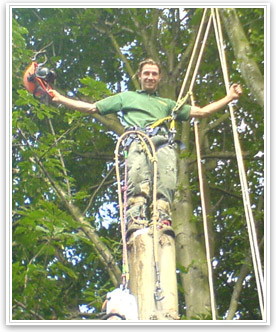 love the job & love being outside.
Despite all the above negative points and the details of the stringient certification required (designed to discourage the faint-hearted, who would only be wasting their time), tree surgery has a high degree of job satisfaction.
It has to have this, and you have to enjoy it, otherwise you just wouldn't bother doing it.
It does take a particular type of person to do this sort of work, it is difficult to exactly say what this is, and I am not going to attempt to.
I have tried to give you an idea of what is involved, only you will know yourself if tree surgery is something that you would and could do. Good Luck.
Comments please
I have compiled this "Jobs in Tree Surgery" web page as an aid to those wishing to start a career in tree surgery (and to save me time in answering daily emails), but it is by no means exhaustive. As the whole arboriculture field is always changing, some information may become incorrect or incomplete. If you find any mistakes or think something should be added then please email me and let me know, or if you have any comments good, bad or don't agree I would also like to know.
Have you found this page helpful?
Email:
Donations
Some people have found the "Jobs in Tree Surgery" page so useful that they have asked to be able to donate a small amount. These donations do help me to keep the page updated, fresh and relevant.
Sometimes people want to email or call for specific questions or to ask for further advice in which case a donation would be much appreciated if you would like me to personally answer your queries and give more specific advice. It all helps me feed my family.
I have set up a PayPal Donate button - All donations gratefully recieved - Many Thanks
Further Reading
We have recommended book lists for those interested in becoming a tree surgeon or those already studying courses in arboriculture. Take a look at our Recommended Books Page for more information
Arborist or Tree Surgeon - Discuss?
There is a tendency to use the term tree surgeon and tree surgery interchangeably with arborist and arboriculture. It should be noted that there is a strong movement in the profession to move away from using the terms tree surgeon and tree surgery to describe what we do.
An arborist is used to refer to someone who has a knowledge
of trees as living organisms, understands when, how and why to perform pruning.
An arborist, as well as knowledge of trees and how they grow, will also have
the skills necessary to operate a chainsaw, climb the tree safely and carry
out the pruning operations.
The distinction being that anyone who climbs a tree with a chainsaw and cuts
'bits' off can and do call themselves a tree surgeon. The bits that are cut
off may not necessarily be the correct bits. They may not even be cut off
a tree that the 'tree surgeon' even knows what the tree is, let alone how
it will respond to pruning.
Within the profession of arboriculture, tree surgeon is increasingly being used to refer to cowboy operators and tree surgery to the work that they carry out.
Having said this, the public at large may very well have never heard the terms 'arborist' or 'arboriculture' and still use the old terms. On the internet and in general marketing many professional arborists and arboricultural businesses will, for this reason, still have to refer to themselves using the terms tree surgeon and tree surgery.
Following on from this then, it is up to all in the profession to help re-educate the public to understand that arboriculture is a profession which specifically deals with the care of trees, and an arborist is a professional who carries this out. Over time these terms will increasingly be used and understood.
Colleges & Training Providers in Arboriculture
NPTC certificates, tree surgery, woodland management e.t.c.
(Many contacts taken from the NPTC website - please let me know if this list is incorrect or incomplete, or if you would like to add your details)
Tree Life - Nationwide
Firmly established in the arb world 'Tree Life' offer top class courses across the country. However please note they teach the management and theory of arboriculture, rather than the pratical tree surgery techniques and chainsaws. See the colleges list below for courses specific to practical tree surgery,.
Both Dave Dowson & Andy Summerley have decades of experience in arboriculture and are excellent at communicating this knowledge to their students. They are independant from the colleges and have an excellent examination pass rate. Well worth booking on a course with them if you can.

Tree Life Head Office and Training Centre.
1319 Melton Road
Braemar Court
Syston
Leicester LE7 2EN
Tel: 01162606939 Fax: 01162606939
Email: keely.treelife@globalnet.co.uk
Web: http://www.treelifetraining.co.uk/
Bedfordshire
Badger Hill Training & Assessment Centre Ltd.
Badger Hill Farm
Clophill Road
Maulden
Bedford MK45 2AD
Tel: 01525 860220 Fax: 01525 861613
Email: lfisher@badgerhillfarm.freeserve.co.uk
BHTAC provides nationwide tree surgery training and independent assessment
for all NPTC tree surgery qualifications in one complete package. Training
and assessment on your site or ours.
Pesticides Application PA1 - PA13 including:
Use of Knapsack sprayers
Mounted or Trailed ground crop or broadcast sprayers
Boat Mounted Sprayers
Granule Applicators
Fogging, Misting, Dipping
Seed Treating etc.
Tractor Driving & Handling;
Tree Surgery Units: Chainsaw & Related Operations; Wood-Chipper Operators;
Self-Propelled Mowers; Abrasive Wheels; Strimmers & Brush-Cutters; All
Terrain Vehicles (Quad Bikes); Forklifts; Landscape Machinery; Safe Lifting
and Handling; Health and Safety Risk Assessment; COSHH Assessment
For further details contact Luke Fisher or Jenny Abraham.
SHUTTLEWORTH COLLEGE
Old Warden Park
Bigglewade SG18 9EA
Tel: 01767 626248
Fax: 01767 626235
Email: jo.handley@shuttleworth.ac.uk
Website: www.shuttleworth.ac.uk
Shuttleworth College provides tree surgery training and a further wide range
of NPTC assessed awards:
Forklift Truck
Chain Saw, Tree Surgery & Arboriculture
Plant Machinery
Manual Handling
Horticultural Machinery
Pesticides
Animal Welfare
For further details contact Jo Handley
Derbyshire
PLS Training
67 Collier Lane
Ockbrook
Derby DE72 3RP
Tel 01332 668298
Mobile 07956104928
Email pls.training@ntlworld.com
PLS Training provides a range of Tree surgery , Arboriculture and Forestry
courses working towards Lantra and NPTC Assessment.
Groundbased Tree Surgery Courses
CS30 Chainsaw Maintenance & Crosscutting
CS31 Felling Small Trees
CS32 Felling Medium Trees
Climbing Tree Surgery Courses
CS38 Tree Climbing & Aerial Rescue
CS39 Operate Chainsaw from Rope & Harness
ABC02 Use of Strimmers, Brushcutters, Clearing Saws
Qualified and experienced in all aspects of Arboriculture (Tree Surgery) and Forestry skills. Registered NPTC Assessor and Lantra Instructor/Training Provider. All courses are carried out in managed woodlands and parks throughout the East Midlands. For further details please contact Phil Smith to discuss your tree surgery training requirements.
East Sussex
MGC
25 Chelston Avenue
Hove
BN3 5SR
Tel/Fax 01273 410339
Mob 07971783962
email: info@m-gc.com
Website: www.m-gc.com
We are International consultants and tree surgery training providers Who work
all over the world providing specialist bespoke training services
In the UK we provide training for Independent NPTC assessment in a wide range
of qualifications (Tree Surgery and more):
Chainsaw
Tree Climbing
Tree Surgery Operations
Brushcutter and Clearing saws
Brushwood Chippers
Stumpgrinders
Mobile Elevating Work Platforms
and many others
For more information please contact Mark Brewer
Herefordshire
7Y RURAL SERVICES NETWORK
Wharton Court
Leominster HR 0NX
Tel: 01568 610077 Fax: 01568 610061
email: audrey@7y.co.uk
Website: www.7y.co.uk
7Y is a leading land-based skills training provider, specialising in NPTC
machinery and tree surgery operations, chainsaw and pesticides. In addition
we have our own fork lift training centre, covering Industrial Masted &
Telescopic, Bobcat and other types of Skid Steer Loaders, ATVs and Plant.
For more information please contact Audrey Thacker
WYVERN TRAINING SERVICES
23 Caradoc Drive
Leominster
Herefordshire HR6 8BH
Tel/Fax: 01568 611042
email:- marlene@wyverntrainingservices.com
Contatct name:- Marlene Flaxman
(A long established, Lantra registered training organisation. Non profit-making.
Training in all areas of the land-based sector, including Health & Safety,
First Aid, Tree Surgery, Chainsaws, Pesticides, Fork-Lift Trucks, ATV's, Horticulture,
Management and Computers.)
Hertfordshire
Hertfordshire
OAKLANDS COLLEGE
Smallford Campus
Hatfield Road
St. Albans AL4 0JA
Tel: 01727 737777 or 07974 964560
Fax: 01727 737752
Email: n.cartwright@oaklands.ac.uk
Website: www.oaklands.ac.uk
Smallford Campus is a well established training centre for the land-based
sector in the South East. Appropriate training and NPTC assessments for tree
surgery and more can be arranged to suit you for the following:
Pesticide Application
Chainsaw & Tree Surgery Operations
Tractor Operation and Maintenance
All Terrain Vehicles (quad bikes)
Wood Chippers
Trimmers, Brushcutters and Clearing Saws
Horticultural Machinery
Adequate training is a vital aspect of your risk assessment so to be sure your are within the law. Please contact Sue Oakley (Administrator) or Nick Cartwright (Course Tutor) for further details on tree surgery and other courses and an application form.
Kent
IAN GOWER ASSOCIATES LTD
7 Blean Square
Vinters Park
Maidstone ME14 5QU
Tel. 01622 675130
Mobile 07946 525298
email ian@pesticides-safety-training.co.uk
website www.pesticides-safety-training.co.uk
Ian Gower Associaties Ltd is a new company with experienced, established trainers
specialising in a wide range of training inervations in amenity horticulture.
NPTC qualifications offered include Safe Use of Pesticides, Chainsaw, Arboricultural
Operations, Tree Surgery, Turf Maintenance Equipment, Brushcutting Operations,
Landscape Plant Machinery and the Safe Use of Mowers.
Integrated training and assessment packages are offered throughout the UK
with Field House Assessments Ltd. For further information contact Ian Gower
on the above number or Fenella Godber on 01580 860444
KINGSWOOD TRAINING SERVICES
Wagoners
Back Lane
Shipbourne
Nr. Tonbridge TN11 9PP.
Contact; Richard Olley
Tel. 01732 811162
Mobile 07973 226727.
email richard@kingswoodtrees.co.uk
website www.kingswoodtraining.co.uk
Registered Instructor No. KINA 04.
We provide training for the following NPTC units to equip the tree surgeon
Groundsman for Tree Surgery
CS30 Chainsaw Maintenance & Crosscutting
CS31 Felling Small Trees
CS32 Felling Medium Trees
CS45 Arboricultural Groundworker
Tree Surgery NPTC tests
CS38 Tree Climbing & Aerial Rescue
CS39 Operate Chainsaw from a Rope & Harness
CS40 Crown Thinning & Reduction
CS41 Tree Dismantling Operations
Machinery for Tree Surgery
ABWC02 Use of Woodchippers
ASG02 Use of Stumpgrinders
AMWP02 Use of Mechanically Elevated Working Platforms (MEWPS)
ABC02 Use of Strimmers, Brushcutters, Clearing Saws
We also offer training for the full range of Electroarb units
London
Treewood Training
28 Weigall Road, Lee, London SE12 8HE
Contact: Peter Irving
Tele: 020-8265-8083
Mobile: 0794-1346758
email: treewoodtraining@ntlworld.com
London's only landbased training provider. Offering training in the following
NPTC Chainsaw units & Tree Surgery NPTC courses:-
Groundsman
CS30 Chainsaw Maintenance & Crosscutting
CS31 Felling Small Trees
CS32 Felling Medium trees
CS45 Arboricultural Groundworker
ABWC02 Use of Woodchippers
ASG02 Use of Stumpgrinders
ABC02 Use of Strimmers, Brushcutters, Clearing Saws
Tree Surgery Courses
CS38 Tree Climbing & Aerial Rescue
CS39 Operate Chainsaw from a Rope & Harness
CS40 Crown Thinning & Reduction
CS41 Tree Dismantling Operations
Middlesex
CAPEL MANOR COLLEGE
Bullsmoor Lane
Enfield EN1 4RQ
Tel: 020 8366 4442 ext 211 Fax: 01992 717544
email: enquiries@capel.ac.uk
Website: www.capel.ac.uk
Capel Manor College is London's leading provider of tree surgery, land-based
training and assessment. In addition to offering a range of full-time and
part-time courses we are a training provider and assessment centre for all
Tree Surgery NPTC Chainsaw and Arboricultural Operation Units and Pesticide
Application Units. Contact Amanda in Student Administration for full details.
Norfolk
Tree Worker Training
White's Cottage,
66 Moor Lane
Sculthorpe,
Fakenham,
Norfolk,
NR21 9PX
Tel: 01328 863620
Mob: 07836 547615
Email: info@treeworkertraining.co.uk
Web: www.treeworkertraining.co.uk
Providers of True tree based tree surgery skills, offering both LANTRA
and NPTC certified courses. Our emphasis is on delivering best Forestry and
Arboriculture practice and tree surgery training at an affordable price. All
courses are delivered by competent, qualified and industrially experienced
trainers.
EASTON COLLEGE
Easton
Norwich NR9 5DX
Tel: 01603 731211 Fax: 01603 731235
email: info@easton-college.ac.uk
Website: www.easton-college.ac.uk
Easton College, Norfolk's college of the countryside, offers a wide range
of bespoke tree surgery training designed to suit land-based industry needs.
In addition, the college is a training provider and assessment centre for
NPTC units such as chainsaws, tree surgery arboricultural operations, pesticides,
forklift truck operations and much more.
For more information contact the Professional Training Centre.
Northamptonshire
MOULTON COLLEGE
West Street
Moulton NN3 7RR
Tel: 01604 491131 Fax: 01604 491127
email: enquiries@moulton.ac.uk
Moulton College has an unrivalled reputation for excellence in training for
the Land Based Industries and Tree Surgery. Set in the rolling countryside
of rural Northamptonshire, it is the ideal place to enjoy your course.
Courses available:
Chainsaw and Tree Surgery Training
Basic Chainsaw Operations (Units CS30, 31 & 36)
Advanced Chainsaw Operations (Unit CS32)
Clear Individual Windblown Trees (Unit CS34
Breakdown Medium Size Broadleaf Crowns (Unit CS37)
Tree Surgery Units
Climb Trees & Perform Aerial Rescue (Unit CS38)
Operate Chainsaw from Rope and Harness (Unit CS 9)
Carry Out Pruning Operations (Unit CS40)
Carry Out Dismantling Operations (Unit CS41)
Assessments can be carried out for all the NPTC Certificates of Competence
for Chainsaw & Related Operations subject to site availability.
PESTICIDE TRAINING
Safe use of pesticides - Unit PA1
Hand Held Applicators - Unit PA6
Field Crop Sprayers - Unit PA2
We also offer training in Forklift Truck Operations, Mobile Elevated Work
Platforms,
All Terain Cycles (Quads), and much more
Lanacashire
MYERSCOUGH COLLEGE
Myerscough Hall
St. Michael's Road
Bilsborrow
Preston
Lancashire
PR3 0RY
Tel: 01995 642222
Email: enquiries@myerscough.ac.uk
NEW for 2007 - Masters Degree in Arboriculture and Urban Forestry
Arboriculture (tree care & management) involves all aspects of the production,
establishment, and management of amenity trees and woodlands such that people
and trees can co-exist in a sustainable environment. Arboriculture Tree Surgery
courses at Myerscough include Higher and Further Education, as well as short
training courses and part-time study
Scotland
SAC Training Services
Business Development Manager
Ferguson Building
Craibstone Estate
Bucksburn, Aberdeen AB21 9YA
Tel: 01224 711068 Fax: 01224 711291
email: kforsyth@ab.sac.ac.uk
Scottish Agricultural Colleges training services include short tailored courses
specific to particular interests including Tree Surgery Courses. For more
information contact Kay Forsyth at the above. SAC have 24 regional offices
located throughout Scotland as follows: Aberdeen, Ayr, Benbecula, Campbeltown,
Cupar, Dumfries, Edinburgh, Elgin, Forfar, Inverness, Inverurie, Kirkwall,
Lanark, Lerwick, Oban, Perth, Portree, St. Boswells, Stirling, Stonehaven,
Stornoway, Stranraer, Thurso and Turriff.
Barony College
Parkgate
Dumfries DG1 3NE
Tel: 01387 860251
www.barony.ac.uk
Barony College situated in South West Scotland, 10 miles
from Dumfries specialises in training and education for the land-based, tree
surgery and animal care industries.
Short courses include:
Groundsman Tree Surgery Units
Chainsaw Crosscutting and Maintenance
Chainsaw Felling (CS30/31)
Chainsaw Felling - Medium Trees (CS32)
Chainsaw Felling - Large Trees (CS33)
Chainsaw Felling - Individual Windblown Trees (CS34)
Forwarder Operations
Brushcutting/Strimming
Chipper
Climbing Tree Surgery Units
Tree Climbing and Aerial Rescue (CS38/39)
Full time courses include:
National Certificate in Forestry
National Certificate in Urban Forestry (arboriculture)
Forest Harvesting (including machine operations)
SVQ2 in Arboriculture or Forest Harvesting
SVQ3 in Forest Harvesting, Arboriculture or Sawmilling
Staffordshire
RODBASTON COLLEGE
Rodbaston
Penkridge
Stafford ST19 5PH
Contact: Short Course Officer
Tel: 01785 712209 Fax: 01785 715701
email: rodenquiries@rodbaston.ac.uk
Website: www.rodbaston.ac.uk
Courses available:
Chainsaw & Tree Surgery Courses
Basic Chainsaw Operator - Units CS30 & CS31
Climb Trees and Perform Aerial Rescue - Unit CS38
Medium Size Felling - Unit CS32
Operate the Chain Saw from a Rope and Harness - Unit CS39
PESTICIDE TRAINING
Safe Use of Pesticides - Unit PA1
Hand Held Applicators - Unit PA6
Field Crop Sprayers - Unit PA2
Suffolk
BTS Training, The Lion Barn, Maitland Road,
Needham Market, Ipswich, Suffolk. IP6 8NZ
T 01449 720330 F 01449 720442
training@btsgroupuk.com
www.btsgroupuk.com
BTS Training offer a wide based, comprehensive range of Arboricultural Nationally
Accredited courses and Assessments including all aspects of Health and Safety
training for both the professional and the occasional tree worker, from climber
to groundsman.
Chainsaw related courses:
Groundsman Tree Surgery Units
• CS30 Maintain & Operate the chainsaw
• CS31 Fell & process small trees
• CS32 Fell & process medium trees
• CS33 Fell large trees
• CS34 Process individual windblown trees
• CS35 Process multiple windblown trees
Climbing Tree Surgery Units
• CS39 Operate Chainsaw from rope & harness
• CS40 Carry out pruning operations
• CS41 Undertake sectional felling operations
• Certificate of competence to climb trees and perform Aerial Rescue
Utility Arboriculture:
• UA1 Basic Electrical Knowledge
• UA2.1 Tree Recognition
• UA2.2 Prune & Fell Trees
• UA2.3 Prune Trees (Aerial)
• UA3 Safety Documents
• UA4 Application & removal of Earths/LV bonds
• UA5 Risk Assessor/Surveyor
Other courses to aid Tree Surgery Operations:
• First Aid: (1 day appointed person + First Aid at work 5 days)
• Pole top rescue
• Understanding/completing Risk Assessments
• Safe Manual Handling
• Safe use and operation of mobile elevated work platform
• Certificate of competence in Brushwood Chipper Operations
• Certificate of competence in safe use of Mowers
• Certificate of competence in safe use of Hedge trimmers
Surrey
MERRIST WOOD COLLEGE
Merrist Wood Campus
Worplesdon, Guildford
Surrey, GU3 3PE
Tel: 01483 884040
Website: www.guildford.ac.uk
Offer chainsaw courses e.t.c. and arboriculture courses
Warwickshire
ACCESS ABORICULTURE
Forestry, Tree Surgery Arboricultural Contractors and Training Providers
7 Bennett Place
Ilmington
Shipston on Stour
Warwickshire CV36 4LW
Tel/Fax: 01608 682978 Mobile: 07814698229
Email: areadtreeexpert@aol.com
Website: www.treeexperts.co.uk
ACCESS offer training for all NPTC Tree Surgery Chainsaw units, Brushwood
chippers, Stump Grinders and MEWPS. We are now able to offer training for
FMO agricultural base skidder and forwarder. WE ALSO PROVIDE BESPOKE TRAINING
E.G. WOOD SCULPTURE (CHAINSAW), 4X4 UNIMOG TYPE VEACAL' MOBILE SAW MILLING
AND GREEN WOODCRAFT (POLE LATHE , HURDLE MAKING) + advanced climbing and rigging
training
Wiltshire
TRAINING EXPRESS
Unit 10, 87 Trowbridge Road
Bradford on Avon
Wiltshire BA16 1EG
Tel: 01225 863963 Fax: 0870 133 4860
Email: info@trainingexpress.co.uk
Website: www.trainingexpress.co.uk
Training Express is a 'one stop shop' for all your tree surgery , land-based,
construction and transport training and assessment needs. We can deliver training
and assessment on site throughout the UK or at our own dedicated Training
Centre and Woodland. Training for Tree Surgery NPTC Certificates of Competence
includes:
All the Chainsaw units, Pesticides and Fork Lift Trucks
For more information contact either Carol or Chris
Yorkshire
TKF Training
Cross Gate Road
Holmfirth
West Yorkshire HD9 1SL
Tel: 01484 685114
email: info@tkftraining.co.uk
Web site: www.tkftraining.co.uk
TKF Training is one of the country's leading independent tree surgery training
providers delivering training to leading utilities, local authorities and
private clients throughout Great Britain and Eastern Europe. As an NPTC Assessment
Centre specialising in tree surgery, forestry, arboriculture, utility arboriculture
and pesticide training TKF Training is ideally placed to administer the full
range of Tree Surgery NPTC Awards.
Training courses can be delivered at our purpose built training centre situated
within a 350 acre commercial woodland near the popular market town of Holmfirth
or on your own site.
For details of our complete tree surgery and other training packages please
contact Sally or visit our website
Geoff Wilson Training
Moor Farm
Moor Monkton
York YO26 8JA
Tel/Fax 01904 738981 Mobile: 07966 520058
Email: geoff@geoffwilsontraining.co.uk
Website: www.geoffwilsontraining.co.uk
Specialist Training Provider in NPTC Pesticide Application modules PA1, PA2,
PA4, PA6A, PA6AW, PA6B, PA9, PA11. Other modules are available on request.
Operating nationwide and provides a complete training and assessment package.
Training is also available in Machinery Operations, Livestock Production,
Chain Saws and Tree Surgery Arboricultural Operations.