
Our Services
Information
Archive & Portfolio
Our Philosophy
Sustainability, Permaculture, Co-operation, Integrity
Introduction
It is generally accepted that our environment has taken a battering due to the activities of humans, especially in the last few hundred years. We see and hear of the consequences of this everywhere.
For us, like many, we recognise and realise that it is
the millions of decisions that we collectively all take that shape our society
and the environment around us. We all have to take some personal responsibility
and believe that the choices that we make can have an effect.
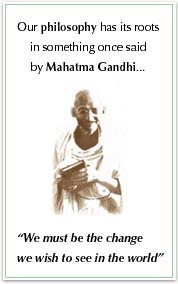
Our philosophy has its roots in something once said by Mahatma Gandhi...
"We must be the change that we wish to see in the world"
Fortunately there is a growing number of people that realise that a change from the 'old' wasteful and destructive days is necessary, not only for our environment, but also for our own feelings of well-being. There is an ever-growing movement towards environmentally & socially conscious work and living; we see it in the papers, on the television, on the internet. True it is mixed in with the reports of environmental catastrophes and atrocities, but all the time there is a growing recognition that things are changing.
This is certainly very evident in the tree industry. At Eco Tree Care & Conservation Ltd keeping up with current thinking and changes in the industry is very important to us. One because it keeps us up to date and on the cutting edge of our profession, and also it gives much inspiration and hope for the future.
For example if one is to look through the recent issues of journals like, 'Forestry & British Timber', 'Essential Arb', The Tree Council's 'Tree News', The Woodland Trust's Broadleaf and the Arboricultural Association Newsletter it is heartening to see many many articles about this change towards environmental thinking.
There are articles on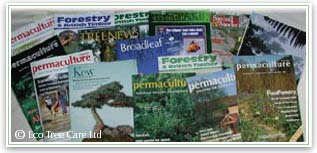 sustainable woodland management, using wood chips as a source of renewable
fuel to heat homes, wood burning power stations supplied by locally coppiced
woodlands, building more energy efficient timber framed houses, new developments
in environmentally-friendly wood preservation, initiatives and grants to plant
more woodland and so on and so on. (see resource)
sustainable woodland management, using wood chips as a source of renewable
fuel to heat homes, wood burning power stations supplied by locally coppiced
woodlands, building more energy efficient timber framed houses, new developments
in environmentally-friendly wood preservation, initiatives and grants to plant
more woodland and so on and so on. (see resource)
Not only do we fit into this change of thinking, we strive to be part of it and make best use of the opportunities and initiatives that are springing up all around. Through our work and interaction with the public we aim to always generate an awareness of our natural environment and the benefits of good tree work and woodland management. We do this, not by preaching or trying to ram a message down peoples throats, but by a simple integrity backed up by high quality work
"Real
progress cannot happen without the driving force of ideals.
It is through the world of work, not just through law or politics,
that we will make the good society”
Abraham Maslow, ‘Maslow on Management’



Sustainability
An International definition of Sustainability often quoted is..
'Development which meets the needs of the
present without compromising
the ability of future generations to meet their own needs' *
It implies living with current natural resources, and using them prudently and efficiently and ensuring that their use is within a constant cycle of renewal. In other words, the rate of using them does not exceed the rate that the natural environment can regenerate them. At the same time, whilst respecting this cycle, we are also protecting the environment by reducing damaging practices and attitudes, and recycling, repairing and reusing as much as possible.
Essential to this perspective is that there be a positive net return, or at least a balance, in terms of resources expended and returned. What can't be ignored in this picture are the hidden costs, such as loss of wildlife & natural habitats, health care costs from chemical exposure, energy expended in transport costs, packaging, disposal and so on.
If all these factors are taken into account then it is easy to see that there are many industrial and retail practices that do not fit into this picture of sustainability.
Activities are sustainable when they:
 Use materials in continuous cycles
Use continuously reliable sources of energy
Secure the use of resources for future generations
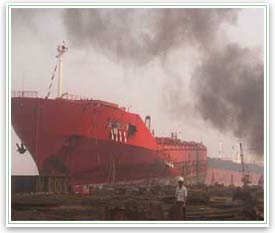
Activities are NOT sustainable when they:
Require continual inputs of non-renewable resources
Use renewable resources faster than their rate of renewal
Cause cumulative degradation of the environment
Require resources in quantities that undermine other people's well-being
Require the input of excessive work undermining a persons well-being
Lead to the extinction of other life forms
Permaculture
Permac ulture
can be thought of as the conscious design and implementation of sustainable
living.
ulture
can be thought of as the conscious design and implementation of sustainable
living.
It is all very well for someone to be able to say, "Ok, I recognise that we need to live sustainably"...But then there is the question..."How do I do it?'
Living sustainably means co-operating with nature. It means developing our lives and work to be ecologically sound, economically viable, and socially beneficial, whilst recognising the needs of everyone else. And as everyone has different lives, jobs, living situations, needs, wants and so on. This is no easy task at all.
One definition is...
Permaculture (permanent agriculture or permanent culture)...
...is the conscious design of agriculturally
productive ecosystems which have the
diversity, stability, resilience of natural ecosystems. It is the harmonious
integration
of landscape and people, providing their food, energy, shelter and other material
and non-material needs in a sustainable way.
Another simpler way to look at is...
"Permaculture simply asks people to put as much into life as they demand from it."
The words of David Bellamy in his introduction to The Permaculture Way by Graham Bell
In order to get away from buzz-words and babble it is important to try to understand what Permaculture means in Plain English...
Permaculture is about developing, designing and researching the 'know how' of bringing about sustainability into our lives. It recognise's the huge diversity of society and realise's that everyone has different needs.
The needs of a family living in a rural environment is different to those of a family living in a high rise building development in the inner cities. It takes people from all walks of life to develop and explore ways in which they can live more sustainably. It is very much about personal responsibility, integrity and growth.
By thinking carefully about the way we use our resources - food, energy, shelter and other material and non-material needs - it is possible to get much more out of life by using less. We can be more productive for less effort, reaping benefits for our environment and ourselves, for now and for generations to come.**
Permaculture draws together the skills and knowledge of many ecologically
sound disciplines
and enables us to establish productive environments which provide for our
essential needs:
Food, Energy, Shelter, Social and Financial structures
The ethics, principles and practice of permaculture can be used by anyone, anywhere:
in city flats, yards and window boxes
suburban and country houses and gardens
allotments and smallholdings
on farms and estates
countryside and conservation areas
industrial and educational premises
on waste ground
Put into practice, permaculture empowers the individual to be resourceful and self-reliant, and to become a conscious part of the solution to the many problems which face us, both locally and globally.
There are practical solutions to our environmental problems. We are not powerless individuals. The philosophy and practice of permaculture empowers everyone, whether we have land or not, to make a significant, life affirming changes and become a conscious part of the solution" ***
The development of permaculture principles in our lives is immensely satisfying as it brings its own rewards of connectedness and awareness. For each of us a deepening of our relationship with natural processes and principles allows us to extend ourselves out into the very fabric of what it means to be alive.
Integrity
Simply...living truthfully and in accordance with our values and principles.
We aim to be socially and environmentally conscious in our work. To be honest in our intentions, and honest in our interactions with ourselves and others.
Integrity is about working and living according to the personal standards that have that feeling of 'rightness' to them. To do anything else quickly leads to dysfunction and unhappiness, to distrust, bad feeling and greed. These negative attitudes fuel environmental destruction, which is why integrity has to be part of any social and environmental change if it is to become more sustainable. It is about trusting and being trustworthy.
"The best pillow is a clear conscience" - Ghandi (again)
On an everyday level this means...
 We quote only for what is necessary, driven by tree care not profit
If we give a day and time for a quote, or job we strive to keep our word,
and be on time
If we are, for whatever reason, unable to keep an appointment we try to telephone
or e-mail to rearrange at the earliest possibility, to avoid inconvenience
Prices reflect the amount of technical expertise and risk involved and of
course, straight-forward hard work. We aim to neither under price or overprice.
Quoting will always be carried out by a qualified and experienced Arborist
who will be able to carefully work out the most cost-effective, yet safe,
method of completing the work involved.
Our waste is important to us. It will be treated in an environmentally sensitive
manner by being recycled when & where possible.
The wood chip from our tree surgery, woodland management, coppicing &
portable sawmilling work is collected for Biomasss electrcity generation by
a power station in Thetford.
Bio-degradable chain oil is used to minimise local environmental damage to
gardens and ponds e.t.c.
Co-operation
Although we are a limited company Eco Tree Care & Conservation Ltd is run like co-operative style of business; this is what makes us so successful
We also co-operate with other individuals and organisations who share our objectives and philosophy. And aim, through the use of modern web technology and communication, to help in the continual networking of like-minded individuals and companies involved in tree surgery, woodland management, wood and woodland products, sustainable building and architecture, conservation, permaculture and sustainability. (see resource)
A co-operative within a co-operative, within a co-operative....
"People who will not sustain trees will soon live in
a world that will not sustain people"
Bryce Nelson
* From the The General Conference of the United Nations Educational, Scientific and Cultural Organization (UNESCO), meeting in Paris in the autumn of 1997
** From Permaculture magazine issue no. 17
*** From Permaculture magazine issue Vol 1 No 2 (Winter 1992/93)